
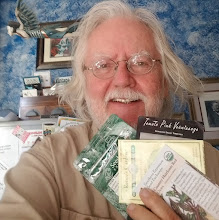
I have quite a collection of seed catalogs for the current year. I’ll order from some, peruse others and ignore the rest. I choose my catalogs carefully for many reasons.
Most importantly, I want to make certain that they are not listed as dealers for Seminis. Seminis is the seed selling arm of the corporate giant Monsanto and any profit Seminis makes helps to fund Monsanto's omnipresent drive to dominate the seed business. Their drive to obtain monopoly status is well-documented and makes for some depressing reading. You can find the seed companies listed as dealers for Seminis on their home page. There you'll find such home-gardener favorites like 'Burpee Seeds' and supposedly organic stalwarts like 'Gardens Alive.'
The listing of these two draws particular attention. I grew up with Burpee; as a kid, in the long winter months of northeast Kansas, I read and re-read the Burpee catalog end to end, marking it up, folding down corners to mark special notations. Honestly, I spent more time with the Burpee catalog than I did with my homework. My grades in those years can prove it. Conversely, my knowledge of seeds doesn't necessarily prove it, but I got my start there by the fire with the gardens covered in a blanket of snow. W. Atlee Burpee and Company introduced a lot of very good vegetables for home gardeners in the late 1800's and early 1900's. They were one of America's premier breeders of vegetables and flowers. Names we know and love today are part of the Burpee legacy; the Golden Beet was a Burpee creation, Fordhook Giant Chard another – anything called 'Fordhook' is a Burpee introduction, that's the name of their research farm. They did amazing work with marigolds and other plants offered primarily to home gardeners.
On the other hand, Gardens Alive has been suspect in my book for as long as they have been around – which isn't nearly as long as Burpee. Gardens Alive promotes pest solutions that are organic, but their attitude towards pests has been anything but organic. I remember one catalog series that was headed “Declare War On Aphids!” Decidedly a non-organic approach. I know, instinctively that 'declaring war' on Nature in any of Her guises is a futile project. Declaring war on nature is the Monsanto way – the concept is that we thinking human beings can out-bomb the bugs and win.
We can't. Never have. Never will.
Every time Monsanto has been out to fight Nature, it has had unexpected consequences. How about DDT in the 1950's. That was a Monsanto product. How about Agent Orange in Vietnam? Another Monsanto product. Bovine Growth Hormone, which is under suspicion as an initiator of human health problems is a current Monsanto product – it has not been tested by outside organizations (current FDA policy has the manufacturer do their own testing which is – oftentimes – rubber stamped by the agency). In addition, there are the genetically modified seeds produced by Monsanto technology. There are others, but Monsanto is the biggest by far. Their inventory of GM seeds is a catalog of what is planted by American farmers today.
Monsanto claims to be feeding the world with their technology, but such claims are bald-face lies which can be undone with very little research. A recent release of data from a 15 year USDA (gasp! the same USDA Monsanto has bought and paid for!) revealed that 'there was no appreciable yield increase' by using GM seeds! Then there is the simple fact that Monsanto does not do research to merely create a higher producing seed. It's not on their agenda. Nor do they do research for a more nutritious seed. That has no appeal to them. All of their research has been done to find a plant that will grow when dosed with the weed killer Roundup. The result is that millions of tons of seeds have been sold that ensures the sale of billions of gallons of Roundup. You have, by now of course, deduced who makes Roundup, right? Yes, Monsanto. So Monsanto's only guiding principle is find out what will make Monsanto's stockholders rich. Sick too perhaps, but hey, that's the price of true wealth, right?
The American nursery trade is a 39.6 billion dollar a year industry. With the purchase of Seminis in January of 2005, Monsanto is now estimated to control between 85 and 90 percent of the U.S. nursery market. This includes the pesticide, herbicide and fertilizer markets. By merging with or buying up the competition, dominating genetic technology, and lobbying the government to make saving seeds illegal, this monolith has positioned itself as the largest player in the gardening game.
Monsanto holds over eleven thousand U.S. seed patents. When Americans buy garden seed and supplies, most of the time they are buying from Monsanto regardless of who the retailer is.
So that's why the diatribes against Monsanto. And now, back to my seed catalogs. So the Burpee and Gardens Alive catalogs are thrown out. Johnny's Selected Seeds is also on the Seminis list, but I don't automatically toss it. Why? The employee owned company has signed the safe seed pledge which declares they will not ever sell 'genetically engineered or modified seeds or plants.' So how do they end up being a Seminis dealer?
In Monsanto's drive to become the only seed company in the world, Seminis has purchased many different seed companies and along with those purchases, they got the inventory and patents of those companies. This means, Big Boy tomatoes are now one of many Seminis/Monsanto products. Profits from Big Boy feed the Monsanto beast. Johnny's gets an exemption from being tossed, but if I find I need to order from Johnny's, I scrutinize my purchases to make certain I'm not buying anything that feeds the beast. Often-times, from Johnny's I am only getting one or two seed varieties that I can't find elsewhere and that's after I've looked far and wide..
My short list of the good guys is, as follows:
BAKERCREEK HEIRLOOM SEEDS; 2278 Baker Creek Road Mansfield, MO 65704; 417.924.8917 What a catalog! Beautiful pictures of the produce – vegetable porn for sure. I have never ordered from them, but I have heard good things about them. Anyone who works this hard in putting out a beautiful seed catalog is working with a great deal of love. Drooling is hardly optional while browsing here. These are the people who perfected 'veggie porn.'
BOTANICALINTERESTS; 660 Compton Street, Broomfield, CO 80020; 720.880.7293. I 'have been dealing with these folks for only a couple of years - I have seen their seeds on seed racks here and there, but I really got to know them for the quantity of seeds they donate to Venice High School and other educational programs. Good seed. Clean. Good variety and a good price. Open pollinated and often heirloom! Great packaging!
BOUNTIFULGARDENS; 18001 Shafer Ranch Road; Willits, CA 95490; 707.459.6410 Organic seed; open-pollinated. A part of the work done by John Jeavons, a proud and active member of the population of organic and open-pollinated gardeners. If you see him, he owes me a laser pointer.
BOUNTIFULGARDENS; 18001 Shafer Ranch Road; Willits, CA 95490; 707.459.6410 Organic seed; open-pollinated. A part of the work done by John Jeavons, a proud and active member of the population of organic and open-pollinated gardeners. If you see him, he owes me a laser pointer.
FEDCO; PO Box 520, Waterville, ME 04903 207.873.7333 They are rabidly anti-GMO, though they do carry hybrids in addition to open-pollinated seeds. A wonderful and extensive selection. Someone who writes this beautiful deserves to get some of our money!
PEACEFUL VALLEY FARM SUPPLY; PO Box 2209; Grass Valley, CA 95945; 916.272.4769 I have purchased many seeds (and a lot of other things!) from Peaceful Valley – I love their catalog. They have an excellent selection of cover crop seeds as well as a lot of organic gardening supplies and tools. I have used their catalog to teach organic gardening because they clearly explain their products and how to use them.
NATIVESEED/SEARCH; 526 N. 4th Ave. Tucson, AZ 85705; 520.622.5561 (Fax 520.622.5591) Specializing in the seeds of seeds of south western United States, concentrating on the ancient seeds of the First Nations People from amaranth to watermelon. A worthy cause for your money. And good seed – some amazing varieties found no where else.
PINETREEGARDEN SEEDS; PO Box 300, Rt. 100; New Gloucester, ME 04260; 207.926.3400 Probably the best economy for a home gardener – small packets of very current seed, a very good value. The smaller packets mean a smaller price so a person can order a lot more varieties and experiment. I have been a customer for many years. Please note that this company, even though they have a fabulous model for the home gardener, has not signed the Safe Seed Pledge so one must make certain that anything you order from them, is listed as 'open-pollinated.' If in doubt, find it from someone else. Pinetree should sign the safe seed pledge and let us all breathe easier about supporting their own gardening philosophy and outlook towards the home-gardener. (N.B. Please see the comment section below for Pinetree's refutation of my comments. I am pleased to have learned I was misrepresenting them.)
SEED SAVERS EXCHANGE; Rt. 3 Box 239; Decorah, Iowa 52101; 563.382.5990 Membership fees $40. Free brochure. Some organic, but ALL open-pollinated. There are two ways to save seeds: one is to collect them all and keep them in a huge building that protects them from everything up to (and including) nuclear holocaust. The other way is to grow 'em. You can find the chance to grow them here. I have been a member for about 10 years and believe in their work; remember a Seed Savers' purchase supports their work and their work is vital to our survival in a post-Monsanto, chemical-deluged agricultural world. They are an essential part of the battle against Monsanto.
SOUTHERN EXPOSURE SEED EXCHANGE; P.O. Box 460, Mineral, VA 23117, 540.894.9480 (Fax: 540.894.9481) A commercial venture that is somewhat similar to Seed Savers Exchange, but really isn't an exchange. They do carry seed saving supplies - nice to have if you are going to save seed.
PEACEFUL VALLEY FARM SUPPLY; PO Box 2209; Grass Valley, CA 95945; 916.272.4769 I have purchased many seeds (and a lot of other things!) from Peaceful Valley – I love their catalog. They have an excellent selection of cover crop seeds as well as a lot of organic gardening supplies and tools. I have used their catalog to teach organic gardening because they clearly explain their products and how to use them.
NATIVESEED/SEARCH; 526 N. 4th Ave. Tucson, AZ 85705; 520.622.5561 (Fax 520.622.5591) Specializing in the seeds of seeds of south western United States, concentrating on the ancient seeds of the First Nations People from amaranth to watermelon. A worthy cause for your money. And good seed – some amazing varieties found no where else.
PINETREEGARDEN SEEDS; PO Box 300, Rt. 100; New Gloucester, ME 04260; 207.926.3400 Probably the best economy for a home gardener – small packets of very current seed, a very good value. The smaller packets mean a smaller price so a person can order a lot more varieties and experiment. I have been a customer for many years. Please note that this company, even though they have a fabulous model for the home gardener, has not signed the Safe Seed Pledge so one must make certain that anything you order from them, is listed as 'open-pollinated.' If in doubt, find it from someone else. Pinetree should sign the safe seed pledge and let us all breathe easier about supporting their own gardening philosophy and outlook towards the home-gardener. (N.B. Please see the comment section below for Pinetree's refutation of my comments. I am pleased to have learned I was misrepresenting them.)
SEED SAVERS EXCHANGE; Rt. 3 Box 239; Decorah, Iowa 52101; 563.382.5990 Membership fees $40. Free brochure. Some organic, but ALL open-pollinated. There are two ways to save seeds: one is to collect them all and keep them in a huge building that protects them from everything up to (and including) nuclear holocaust. The other way is to grow 'em. You can find the chance to grow them here. I have been a member for about 10 years and believe in their work; remember a Seed Savers' purchase supports their work and their work is vital to our survival in a post-Monsanto, chemical-deluged agricultural world. They are an essential part of the battle against Monsanto.
SOUTHERN EXPOSURE SEED EXCHANGE; P.O. Box 460, Mineral, VA 23117, 540.894.9480 (Fax: 540.894.9481) A commercial venture that is somewhat similar to Seed Savers Exchange, but really isn't an exchange. They do carry seed saving supplies - nice to have if you are going to save seed.
Transnational corporations can't build communities, they can't celebrate identity. Only we can do that, and we can do it with every seed we plant. (ibid)




 Posts
Posts


.jpg)