Search This Blog

22 June 2011

The Forsaken Garden: The Food Humanity Forgot, Part 2

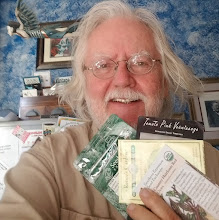
Corn is one of the most hybridized plants in our world today, but most of the hybrids developed in the past 50 years has nothing I want in my garden.  This ancient race of corn, at present not precisely identified, from the Native Seed/SEARCH collection does have traits I want: It is a dent corn, meaning it has the keeping qualities of a flint combined with the finer grain of a flour corn.  The blue tint holds higher nutrition. One of my projects now is to develop a blue (higher nutrition), dent corn (longer shelf life and finer grain - dents also tend to be among the more productive corn races). I have two corn breeding projects on the books right now.

Even by the time the professionals were breeding plants – before the genetic modification started – the intent was no longer to breed plants for any kind of long term strategy. Just like modern Wall Street, the idea became to get in, make a buck and not be around when the thing imploded. Home gardeners and food consumers became the victims of this make-a-buck strategy. Mind you, the mantra of the promoters of this type of agricultural advancement was: Cheap food – at any price. And no other country bought it up the same way Americans did. And still do. What's the best food store has almost always been the cheapest – a mold that is being broken by Whole Foods Market and that's about the only bone I'll throw them.

It's an odd thing that among 1st World Countries, Americans are the most likely to think food has to be cheap. And, in that guise, we went along for it. Cheap and easy was our national anthem from way before the American Revolution. But the trade offs were huge! Nutrition and taste were not important and were not considered as a 'desirable' outcome of the research.

During this time, the old kind of plant breeding comprised an ever shrinking portion of the plant breeding. And while modern science was breeding in disease resistance to tomatoes and other vegetables, the open pollinated plants were left alone. “Breeding resistance” into plants is another way to describe “breeding more virulent diseases” because, as the plants become resistant, diseases co-evolve to take on the new, improved plants. The net effect of this is that our cherished heirlooms have been compromised by a lack of disease resistance to diseases that weren't around when our treasured plants were being bred.

Now is the time to move beyond 'saving heirlooms.' That is old hat. We have saved a lot of them. Now, we must begin to move beyond just 'saving' them. We must begin to adapt them to our world. We need to confer disease resistance on these tasty and rich jewels of cuisine if we are going to be able to keep them and if they will be the basis of an agriculture that keeps us from starving when the chemicated, profit driven agriculture turns on us by failing to deliver – which it will do sooner or later.

So the challenge before us is to do the work of breeding disease resistance from the hybrids (not the GMOs – which is a different critter altogether and among our people is considered a contamination. There are many hybrids out there from which we can cull disease resistance or other qualities we find desirable in our food. In other words, the word 'hybrid' cannot be a bad or nasty word – we have come to a place where the word 'hybrid' has been far too demonized. It is true that the recent history of hybrids is tied in with the mad rush for profit, but the word itself simply means the 'product of a cross.' Hence most of our rich diverse, collection of open-pollinated plants are all hybrids; the difference that needs to be noted is that the open-pollinated plants are stable crosses – whereas the hybrids of the dollar are unstable crosses – in other words, they have not been grown out for successive generations to insure the good qualities are there to stay.

This work has begun already.  Organic Seed Alliance in Oregon and Practical Farmers of Iowa both have breeding programs, although both are focused on farming crops. 

Many organizations have been saving all this marvelous germplasm that is the basis for this work.  We need to get busy - not only in continuing to save the germplasm, but also to breed resistance to the delicious tasting food our ancestors left for us. We need to be true to this treasure and the way best to do that is to not only save it as it is, but to breed it to compete in this modern world and produce fruit reliably and honestly for our children and their children.

david 

21 June 2011

The Forsaken Garden: The Food Humanity Forgot, Part 1

For all of the history of agricultural civilization, the farmers and gardeners saved their seeds to have something to plant next year.  As soon as humankind began to depend on crops grown in tended fields, saving seeds was as much a part of the process as was planting seeds the following growing season. 

This is the way it was, each generation of humans selecting the seeds that would be the food of the following year.  In this manner, humans were 'breeding' their crops for characteristics they found desirable.  Larger grains, resistance to falling apart in the field before they could be harvested and so on.  It was not called 'breeding' but it was breeding.  Every choice to save one seed over the others in the basket or on the plant was a decision that carried some genetic information forward and left others to be eaten. 

We know this is true because ethnobotanists can look into the detritus of past civilizations and tell within a few years of when a crop becomes domesticated.  The change from a wild seed crop to a domesticated seed crop is dramatic and fairly rapid.  Seed heads become more uniform, the seeds are larger, they don't fall apart easily in the field and other characteristics clearly delineate the departure from 'natural selection' to human selection.

It continues this way over all history.  Up until about the 1950's.  In the late 1800's seed companies sprang up to help people experience other seeds, lending a diversification that gardens hadn't been able to have unless the owner traveled a bit or had connections in other parts of the land.  The average gardener didn't have access to anything that wasn't local.  But seed companies made a lot of seed available to these gardeners and expanded the ability of regions to grow seed adapted to their areas from other similar climates that may not be nearby.  

Still, barring a disaster, once a gardener purchased the seed, the gardener would save seeds for future plantings until some other seed tantalizingly calls to be planted (we all know what that feels like). Seed companies also tried to breed new plants to be able to offer something new each year.  This was the heyday of many great American seed companies that became institutions, like Burpee, introductions we are all familiar with were bred at Burpee's Fordhook Farm - including Fordhook Swiss Chard.  Other plants were bred by a horde amateur seed breeders - including the mechanic 'Radiator Charlie' who paid off his house with sales of seeds of his  "Mortgage Lifter" tomato.

I remember many winters as a child in Kansas, sitting in front of Grandpa's woodstove with snow all over the garden.  I went through the Burpee catalog, Park Seeds and many other seed proprietor catalogs underlining dozens of plants I wanted Grandpa to order for the coming year - I read each catalog hundreds of times, memorizing the descriptions and the names and adoring every single variety - the Burpee catalog in those days was many, many more pages long than it is today.  Grandpa never did, by the way.  He saved his own seeds for the most part and, if he needed more seed, he bought locally.  I didn't understand this until I was an adult growing my own seeds and feeling a little sheepish at how demanding I was about ordering seeds that Grandpa didn't want or need.

Up until the 1950's, one thing that was true of ALL plant breeding was done by amateur plant breeders. Sometime around the 1950's breeding began to fall into the hands of college educated plant breeders - people well versed with genetic backgrounds - and the beginning of commercial funding of science research.  The focus shifted from regional seed production to national and international seed sales and companies more interested in profit than in 'traditional values' of the older seed breeders.  Run on that Republican traditional value politicians!  

This became the years of the hybrids and crop yields went through the roof!  But the concentration was entirely on bushels per acre and very little else.  In many cases the plants required disease resistance in order to produce well and that was bred into the plants.  I don't want to disparage many advances made in this time frame because a lot of valuable work was done that should not be thrown out simply because the primary interest was in selling hybrid seeds.  

Mind you, to me, the line was crossed with genetically modifying plant seeds.  And patenting seeds. This is one more of the incursions the 'industrial' model of agriculture.  Once the industrial model was applied to agriculture, and profit became the only motive, agriculture as a whole was set adrift, and no part was more adrift than plant breeding.  The point was to make profit and keep making profit for as long as possible.  Hence, patents were 'necessary' and positive traits, valuable to individual gardeners and farmers and the eventual consumers (like taste) became lost in the race for profit.  By the time I became an adult gardener in the 1980's, seeds no longer were the seeds of my grandfather.

More on this tomorrow: the next frontier for garden seeds.

david
for the Seed library of Los Angeles, SLOLA

19 June 2011

Greener Gardens Offered By UCLA Extension in Summer Quarter

Orchid Black and I on a field trip Spring Quarter 2010, the last time we taught ‘Greener Gardens: Sustainable Garden Practice’ 

UCLA Extension offers this class in Summer Quarter this year, starting Thursday, June 23, 6:30 PM in Botany 325, on the UCLA campus. People who take this class will get the benefit of the breadth of experience that each of us brings to sustainability in the garden. This class fulfills an elective for the certificate programs in both Horticulture and Global Sustainability.

We will cover sustainable design, soils,  swales and earthworks, appropriate use of greywater and rainwater harvesting, along with the basics of native and drought-tolerant planting. All aspects of sustainable backyard food will be addressed.

The UCLA Extension catalog, lists the class as follows:

“Sustainability is today’s buzzword and many people seek to create a lifestyle with a more favorable impact on the environment. From home and school gardens, to commercial sites, our gardens present the perfect place to start. Designed for horticulture students, gardening professionals, educators, and home gardeners, this course focuses on turning your green thumb into a “greener” garden. Topics include composting, irrigation, water harvesting, water wise plants, eating and growing local produce, recycling, and moving away from a consumptive, non-sustainable lifestyle when choosing materials and tools. … “

I taught this course as a half elective on my own for two years before being able to team up with Orchid. Her knowledge and effective teaching puts this class into its own league.  Orchid is an award winning designer of California Native gardens, a delegate to the state-wide organization of the California Native Plant Society and did excellent work on the Los Angeles County Native Oak Ordinance Working Group. She has studied water issues for several years and has a keen understanding of the problems we face around that issue. She blogs at Native Sanctuary.

On another front, I return to Los Angeles on Sunday the 26th and be a panelist for the upcoming Dwell on Design event.  In the mix of the events right now, I was quoted by the Los Angeles Times in their article on the Seed Library of Los Angeles. 

Here’s a link to UCLA Extension page for the class, which still has a few spaces open:

13 May 2011

Resilient Food Systems Begin with Locally Adapated Seed

I have been reading a The Resilient Gardener, by Carol Deppe - she's the one who wrote 'Breed Your Own Vegetable Varieties: The Gardener's and Farmer's Guide to Plant Breeding and Seed Saving' which I love so much.  Deppe is a wonderful thinker and I love the concept of honing our gardening skills to be better gardeners when times are good so we can carry on when times aren't so good.  She makes a good case for this kind of thinking using examples from her own life and from the greater society. 

Resilience has become a buzzword because of the Transition Town movement that started in England.  I allow that resiliency is a good goal, but it's a tricky one to achieve here in Los Angeles, dependent so much, as we are, on imported water and the electricity it takes to get it here.  Still, allowing for that, Fred Kirschenmann has written a blog post on saving seeds as one of the first steps in developing a resilient gardening paradigm.  
 
The blog post and the book are both well worth your time.

david

21 April 2011

How Mulch Is Too Mulch?

A fresh load of compost/mulch was delivered at The Learning Garden and I got to run my fingers through this stuff right off the truck!  Gardeners love the way this stuff smells.  Mere humans often dislike it. Compost can be a mulch - it is not necessarily 'mulch' but can be used as one. 

Jeanne Kuntz is preparing a post for over at Mar Vista Patch using a clever play on the word 'mulch' (Mulch to be Grateful For) so, I couldn't resist getting a little punny here.

A bit of Q & A between myself and Jeanne follows:  


JK:  How does mulch condition the soil?

When mulch is laid on soil, it stops sun rays from hitting the soil and baking the top layer.  The mulch also prevents water evaporation by breaking the water column in the soil.  (Water molecules stick together and 'pull' water through the soil.  In evaporation, one molecule evaporating causes the next molecule to move towards the surface to evaporated.  When the soil medium is no longer homogeneous, i.e. mulch on top has a different consistency than the soil, the water column is broken and evaporation of below- surface water is stopped.) 

But mulch's big contribution to the soil is that it provides food for a whole host of critters in the soil that break the mulch down.  Mulch feeds the micro and macro life of the soil and THAT increases soil's fertility.  One of the main critters chowing down on the mulch is the earthworm.  The earthworm makes a tunnel from below to the surface to chow at the mulch banquet, grabbing a plateful, which the earthworm carries below the surface, creating yet another tunnel.  Many earthworms = many tunnels - painlessly, effortlessly creating the same delicious soil tilth we used to double dig, breaking out back, to achieve.  I've got garden beds that have never been dug and you can easily put your hand into them as though I had spent days out there sweating by double digging.  

What is the main difference between the various types of mulch?

Well, 'mulch' is technically anything you put on the surface of the soil to protect it.  That includes rocks and plastic and other materials.  We are, I think, talking about 'organic mulches' - the ones that used to be plant material (leaves, wood chips, compost or even bagged materials like 'organic compost' or 'planters mix') and they have differing effects on the soil.  If it is broken down to the point of being more black than not, it does what I was saying above.  The differing mulches will contribute slightly different nutrients to the soil, but, in the main, there isn't much difference in their action - some will break down more slowly and some more quickly, but they will all break down and feed your soil biota.

JK:  Is there are difference between how one uses mulch for edibles vs ornamental plantings?

I wouldn't think so.  I think mulch in flower borders is much more attractive than dirt - it saves water and cuts down on the need of fertilizers.  I add mulch about three inches deep in spring and in fall and that's all I add to my garden, ornamental or veggie. 

JK:  Is the mulch you have at The Learning Garden at Venice High School available to the public?
The Learning Garden's mulch is from Los Angeles Bureau of Sanitation and is delivered to us because we make it available to the community at large.We are open Wednesday through Sunday, from about 10 to about 5:00 - I say 'about' because I'm there alone and if I have to pick something up from the hardware store or go to lunch, that means we're closed for that amount of time.   

And by the way The Beautiful Food Garden Blog turns three today!  Thank all of you for your support!

david

18 February 2011

Loss of a Mentor

Jim Otterstrom died January 22nd, his memorial service will be held in his home town of Big Bear. 

Jim, and his wife Peggy, became my friends through my association with Orchid Black. They were close friends of hers, living a lifestyle that closely approximates her dreams. I spent only a few hours with Jim and Peggy, but found them to be like-spirits and I too admired their car-less life that had such low impact on the earth. Jim took fantastic photos and posted them to his blog. Peruse some of them if you will.

Orchid will read some poetry and I will play a couple of songs in the memorial service. He had head me play these songs the first night I met him and he approved of them. Music and art of all kinds figured large in Jim's life. The memorial service has been lovingly titled, “Otter-Strum” with a large of host of talented musicians of all flavors.

I wish I had many more hours with Jim in his garden, with his chickens and in their home. It inspired me to press on with my personal vision of how my life will be. I owe him a debt that will probably only be repaid by living the life of my own dreams, in my own way, on my own land.

I am grateful that I was offered the opportunity of knowing Jim Otterstrom. 

david 


Urban Homestead, Urban Homestead, Urban Homestead

A 'city-chick' pecks in her 'urban homestead' yard.  Doubtless she doesn't care about the controversy and maybe we could take a cue from her.  

There are major forces arrayed to stop people from living the homestead dream – in the city and in the country. There are big corporations that believe you need to pay them before you can plant a garden – or that you should not bother to plant a garden at all but buy your food from supermarkets – food that has been grown from trademarked and patented seeds, grown with trademarked and patented inputs like fertilizer and pesticides. The homestead movement, both urban and rural, has a huge fight on its hands everyday of the year against these corporations and the government they control.

On Facebook, the biggest buzz between most of my friends has not been against Monsanto or the Obama administration, or events in Egypt but against one of our own: Path to Freedom, a pioneering family (the Dervaes) project in Pasadena, trademarked the term “urban homestead” and began sending cease and desist letters (NB:  OK, so technically they are not 'cease and desist' letters, not actually using those words... However, read what the Dervaes posted - in their own defense - and tell me if that is an unfair characterization.)   to other urban homesteaders. It was a shock that one of the leaders in this field had become the 'other' and indulge in the same practices associated with land rapers and profiteers.

Let there be no mistake: It is hard to discount the inspiration, if not applicable information, from the Dervaes family. I got to visit their homestead before they were the famous icon of the movement they became. By that point, tours of the homestead were not on their agenda, they were too busy with increasing productivity. Their blog is often referenced in conversations and many people in the homestead vein relish telling newcomers about the chickens, ducks, goats and amazing productivity of the Path to Freedom project.

But we now are fighting between ourselves, those of us who are, or wish to be urban – or rural – homesteaders. Most are aligned firmly against the Dervaes' family simply because they recognize that this is headed to wasted energy that should be used in furthering the cause. There is no ultimate 'urban homestead' worthy of the trademarking of the name. There will never be. It, like the people who flock to be homesteaders, is an ever evolving idea, concept. To attempt to trademark the name is as foolish as an attempt to pin the concept to the present time.

Why even try? There was some feeble defense on the Dervaes' blog that they were trademarking it so the term couldn't be co-opted by industrial imitators. Good move. We know how 'organic' and 'natural' mean nothing any more because they have become ad terms describing something more natural, say, than steroid injections. However, if that was the real idea, why did the cease and desist letters go to those who aren't industrial – the Institute for Urban Homesteading, Eric Knutzen who authored, “The Urban Homestead” or Santa Monica Farmers' Market Association when they did a seminar on the subject? If that was honestly the thought behind the trademarking move, it begs even further explanation because the targets ostensibly were on the same side of the Dervaes family's ideology. It doesn't make any sense.

I conclude it was hubris. The Dervaes have done much and much is owed to them. Somehow, though, they seem to feel that they deserve homage more than recognition. They seem to feel that their advances in urban homesteading are so complete and revolutionary that they alone have the right to be 'urban homesteaders.' This is not true. They wish to deny all of those, for hundreds of years, that went before them, with no trademarks on anything they did, and those that will follow and will take the urban homestead to even greater pinnacles. 

On their website they state:  "We have now secured registered trademarks for certain unique names and images. By protecting our intellectual property we are better able to ensure that our work is presented accurately and contributes to our sustainable living projects and educational initiatives."  Unique?  Our intellectual property? Our work?  Our sustainable projects? They obviously believe that they somehow have come to own 'urban homesteading' which would come as a surprise to the many who have been doing this for years and selfishly wish to protect 'their intellectual property' at the expense of an entire movement.  Sorry, no one can own it more than any other can own it.

You cannot trademark this movement. It moves. It is constantly in flux. It grows. It recoils. And it eats those who think they have mastered it. It is a world of individualists that don't pay homage to a leader. In fact, one of the central ideals of homesteading, predating the 'urban' part, is anti-authority.  I don't believe that homesteader gives a rat's ass for the legal system to begin with.  And then to invoke trademark challenges against your own?  

I hope that we can soon return to our normal diatribes against our real enemies. I pray that the Dervaes family withdraws its poorly-conceived trademark ownership and spends its time and money on making a better ideal for all to follow and allows other urban homesteaders to do the same. This is not a battle we need.  Under even the best circumstances, the Dervaes family has abdicated their roles as leaders and sadly will be known as 'plays poorly with others' more than for their innovation and hard work in making their own urban homestead a truly innovative site in the homestead pantheon.  


While it will move through the courts, here the battle is over.  Let's move on.  We have real work to do.

david

The Calendar of Events At The Learning Garden

Followers